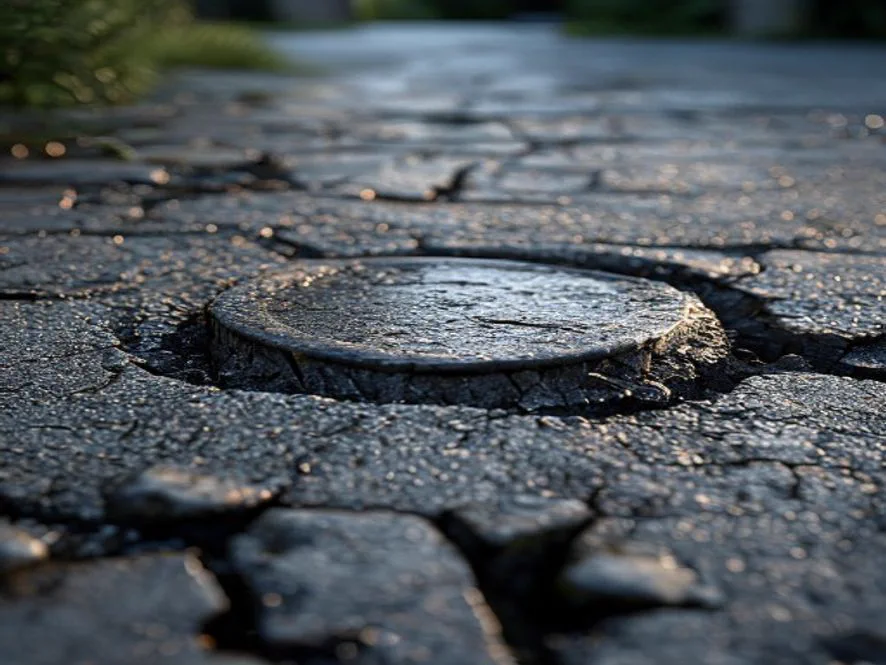
Short answer: Asphalt sinking around utility cover frames happens since crews can't pack the soil tight next to the metal. Water sneaks into that loose spot. Frost lifts the frame. The asphalt settles and cracks in a ring. The lasting fix is to cut out the bad ring, rebuild the base, and repave.
Why asphalt sinking around utility cover edges happens
A utility cover sits in a heavy metal frame. That frame is solid and rigid. The soil right next to it's not. Crews can't swing a big roller tight against the metal. So that little ring of base never gets packed hard.
Loose base means weak support. Cars roll over it day after day. The asphalt has nothing firm under it. So it slowly sinks. A crack opens in a circle around the cover. You see it first as a thin gray line.
So the failure is built in from day one. The only question is how soon it shows. This happens on driveways, parking pads, and streets alike. It's not bad luck. It's just hard to compact next to a fixed object.
Picture a roller the size of a small car. It can't squeeze into the last few inches by the frame. So crews finish that gap by hand. Hand work is good, but it rarely matches machine power. Heavy trucks then pound that soft ring. A loaded van drives it down a little more each pass. So the weak spot is almost baked in from the start.
Water and frost make it worse
Once a crack opens, water gets in. Rain runs down the gap and into the base. Wet soil is soft soil. It shifts under load. The sinking speeds up from there.
In cold places, frost adds a punch. Water under the frame freezes and swells. It lifts the metal a little. Spring comes and it drops back down. Up and down, year after year. That freeze cycle tears the asphalt apart.
The metal frame also heats and cools faster than asphalt. They swell at different rates in the sun. That alone loosens the bond at the edge. Add traffic and water and the ring gives way.
Drainage plays a big part too. If water pools near the cover, the base stays wet. Wet base has little strength left. Good slope sends water away and slows the damage. Watch the spot during a hard rain. If a puddle forms over the cover, the base is already giving up. That standing water speeds the slide downhill.
How bad it can get
At first you just see a thin ring crack. It's easy to ignore. But it grows every season. Here's the usual path it follows.
- Year 1: a hairline ring crack shows up.
- Year 2: the ring widens and chips.
- Year 3: the asphalt dips and holds water.
- Later: a pothole forms and the frame sits high.
A raised frame is a trip and plow hazard. It can catch a snow blade and rip up more asphalt. It can bend a rim or jolt a stroller. So it pays to act before that stage. The longer you wait, the bigger the repair.
The dip itself becomes a trap. Water sits in it after every storm. That water soaks straight into the weak base. So the low spot makes itself worse over time. It's a loop that only gets faster. Break the loop early and you save real money. Wait, and the repair grows with the hole.
Can you just fill the crack
You can fill it, but it'll not last long. A crack filler stops some water for a season or two. It doesn't fix the loose base below. The ring will keep sinking under the filler.
I have seen folks fill the same ring five summers in a row. It looks fixed for a month. Then the dip returns with the next rain. For small surface cracks elsewhere, filling is fine. Learn the difference in our guide to types of driveway cracks. A ring crack at a cover is a base problem, not a surface one.
Hot pour filler is better than nothing for a season. It buys time until you can do the real job. Just don't expect it to hold for years. The base is still loose down there. Think of it as a bandage, not a cure. Plan the full fix for the next dry stretch. Your wallet will thank you later.
The real fix goes down to the base
The lasting fix means going down to the base. You cut out the failed ring. You pack fresh stone tight. Then you repave the patch. It's more work, but it holds for years.
This is the same logic behind any settling repair. Bad base in, bad result out. Good base in, good result out. There's no shortcut around solid compaction.
The good news is the area is small. A cover ring is usually a few feet across. A skilled crew can do it in part of a day. The steps below show how a pro does it.
A good crew checks the soil at the bottom. If it's soft and wet, they dig deeper. They may add fabric or more stone. Solid ground under the stone is what makes it last. The seam seal at the end isn't optional either. It locks out water at the new edge. That one bead of sealer adds years.
How long the repair lasts and what it costs
A full base rebuild is worth the effort. Done right, it can last 10 years or more. The cost depends on the size of the ring and your area. A single cover patch is a small job for a paving crew.
Compare that to filling the crack again and again. Each refill buys a year, maybe two. The sinking never stops. Over time you spend more and still have a bad spot.
Get a couple of quotes before you book. Ask if they compact by hand near the frame. A crew that skips that step will leave you the same problem. The right method matters more than the lowest price.
Ask for a written scope before work starts. It should list the cut size, the base depth, and the seal. A clear scope keeps everyone honest. It also helps you compare bids fairly. Watch for a bid that seems too cheap. It may skip the deep base work. That's the part that actually lasts.
How to keep it from coming back
Good compaction is the key. A careful crew packs the base by hand near the frame. Hand tampers reach where big rollers can't. That one step prevents most sinking. Ask your contractor about it up front.
Seal the seam each time you sealcoat the drive. Keep the cover frame at the right height. Watch for the first hairline ring and treat it early. For the full repair playbook, see how to repair an asphalt driveway.
Want the industry view on doing it right? The National Asphalt Pavement Association shares solid basics on bases and joints. Good base work always wins in the end.
Catch it at the hairline stage and you save a bundle. A tiny ring crack is a quick seal job. A deep pothole is a full rebuild. Early action is the cheapest action by far. So walk your drive each spring. Look at every cover and frame. A two minute check can save a big bill.