"Should I resurface or replace?" is the highest-stakes driveway decision a homeowner makes. Resurfacing costs about half as much, but only works if the base is sound. Replacing costs more up front but resets the clock to 25 years. Pick wrong and you pay twice. This guide gives the decision rule that contractors actually use, the cost math, and the warning signs that flip the answer. For the deeper overlay question, also read overlay vs tear-out.
What "resurface" and "replace" actually mean
- Resurface (overlay): Mill or grind off the top 1 to 1.5 inches of existing asphalt and lay 1.5 to 2 inches of new hot mix on top. The base stays in place. Faster, cheaper, less disruptive.
- Replace (tear-out): Remove the existing asphalt completely. Often remove and replace some or all of the base. Lay a fresh 2.5 to 3 inch driveway from a fully prepared base. Slower, more expensive, full reset.
The cost gap (2026)
- Resurface: 3 to 7 dollars per square foot. National average 4 to 5.
- Replace: 7 to 15 dollars per square foot. National average 9 to 11.
- Driveway 1,000 sq ft: 3,000 to 7,000 to resurface vs 7,000 to 15,000 to replace.
- Driveway 600 sq ft: 1,800 to 4,200 to resurface vs 4,200 to 9,000 to replace.
Run your numbers through the cost calculator. The replacement cost roughly doubles the resurfacing cost.
The lifespan gap
- Resurface over sound base: Adds 8 to 15 years.
- Resurface over failing base: Adds 1 to 3 years before the same cracking pattern shows through.
- Replace: 15 to 25 years on a fresh build, sometimes longer if the base is upgraded.
Base condition is what makes resurfacing valuable or wasted. The Federal Highway Administration publishes the same logic for highway pavement preservation: an overlay only adds life if the structure under it is sound.
The decision rule
Walk the driveway and check these. If you can answer "no" to all five, resurfacing is the right call. If you answer "yes" to any one, the answer shifts toward replacement.
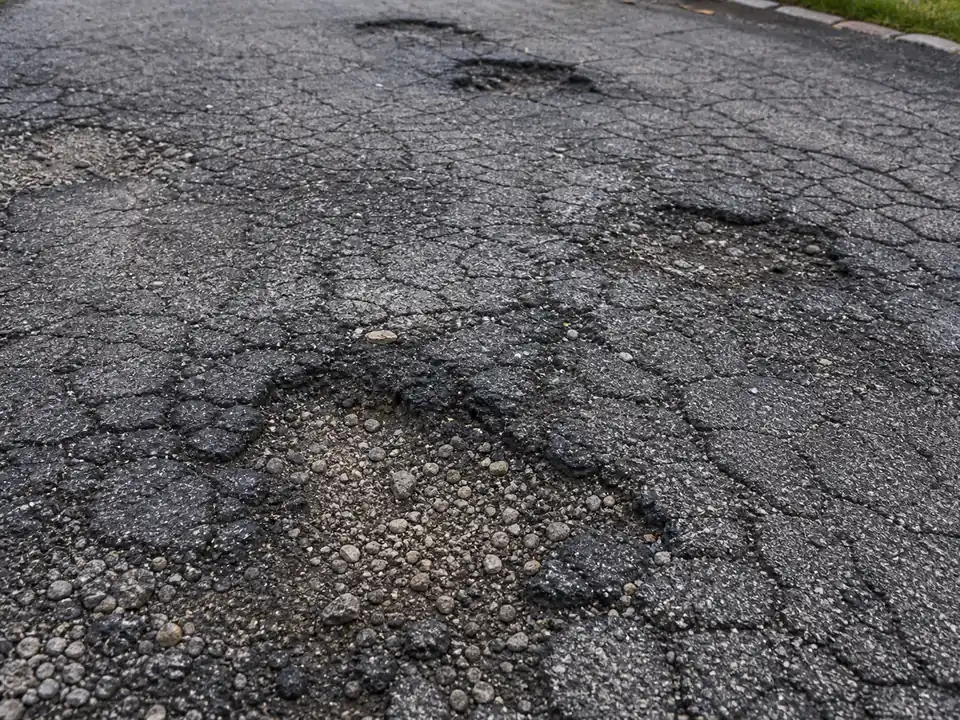
- Is alligator cracking covering more than 30 percent of the surface? Yes means base failure. Replace.
- Are there settled or pumping sections under traffic? Yes means base movement. Replace.
- Do the same potholes keep reopening after multiple repairs? Yes means base failure in those spots. At least cut-out repair, possibly replace.
- Does standing water pool after every rain? Yes means drainage failure. Replace and re-grade.
- Is the existing asphalt thinner than 2 inches? Yes means an overlay will not have enough structural depth. Replace.
What about partial replacement?
Sometimes the right answer is replace the failing 30 percent and overlay the rest. Cut-out repair removes the failed sections, the base gets fixed in those spots, and an overlay goes over the entire driveway. This middle path saves money compared to full replacement and lasts longer than a straight overlay over partial failure. Most paving contractors offer this; ask.
Other questions that move the answer
- How long are you staying in the home? Resurfacing is fine if you are selling in 5 years. Full replacement makes more sense if you are staying 15 plus. The National Association of Home Builders tracks remodel-vs-replace ROI patterns that line up with this rule.
- Is curb appeal a goal? A fresh resurface looks great for the first few years. A full replacement looks new for longer.
- What is your budget today? Cash today vs cash in 8 years is a real factor.
- What does your existing thickness tell you? If the original install was thin or low quality, replacement is usually the right reset.
What happens during each project
Resurface (1 to 2 days):
- Crew arrives with paver, roller, transfer trucks.
- Mill the top 1 to 1.5 inches of existing asphalt.
- Apply tack coat for bond.
- Lay new hot mix to 1.5 to 2 inches compacted.
- Roll for compaction.
- Drivable in 24 to 48 hours.
Replace (3 to 5 days):
- Crew arrives with excavator, paver, roller, trucks.
- Tear out and haul existing asphalt and possibly some or all of the base.
- Re-grade for drainage.
- Lay and compact new aggregate base (4 to 6 inches).
- Lay and compact new hot mix (2.5 to 3 inches).
- Drivable in 24 to 48 hours.
How to get an honest answer from a contractor
Some contractors push resurfacing on every job because it is cheaper and easier to sell. Some push replacement on every job because the margins are higher. Honest contractors look at the base, the cracking pattern, and the existing thickness, then recommend based on the data. Three things to ask:
- "What is the existing compacted thickness?" If they do not measure, they are not estimating honestly.
- "Where is the alligator cracking and what does it tell you about the base?" Tests their diagnostic skill.
- "What is the warranty on each option?" Replacement warranties are usually longer because the structural reset is real.
Score every quote with our quote checker.
References for the cost ranges, lifespan figures, and base assessment guidance are on the sources page.