Short answer: a driveway built right will hold a heavy EV just fine. The risk is not the total weight. It is three things at work. Point load, heat, and a thin or weak build. Get those right and your Cybertruck or Hummer EV is no threat. Get them wrong and you may see ruts where the tires sit. Let me walk through why.
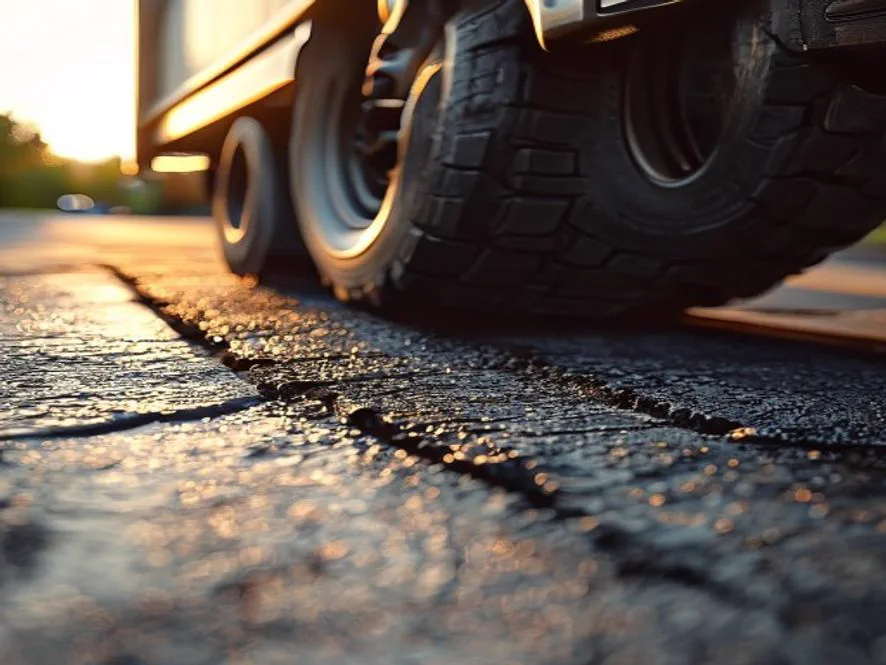
How heavy are these trucks?
A lot heavier than what driveways were built for. Here is how the big electric trucks stack up against a normal car.
- Tesla Cybertruck: about 6,600 pounds.
- Rivian R1T: about 7,000 pounds.
- GMC Hummer EV: about 9,000 pounds.
- Normal sedan: about 3,500 to 4,000 pounds.
So a Hummer EV can weigh more than two sedans. That sounds scary. But weight alone is not what hurts asphalt.
Why weight is not the whole story
The whole truck rests on four small spots. That is where the tires touch the ground. Those small spots are the point load. A heavier truck pushes harder on each one. On a cool, firm driveway it shrugs that off. On a hot day, asphalt softens. Now a parked tire presses on that soft spot for hours. That is when a rut can form. The same heat trouble shows up in the summer softening guide. It explains why asphalt goes soft in the first place.
So the real risks are simple. Hot weather. A thin surface. A weak base. Fresh asphalt that has not cured. Stack two or three of those. Then a heavy EV can leave a mark. Avoid them and it will not.
When your asphalt is most at risk
Three moments matter most.
1. Hot summer afternoons
Asphalt is firm in spring and fall. In a July heat wave it gets soft and easy to dent. Park a heavy truck in the same spot through the hottest hours. That is the classic cause of a rut.
2. A thin or cheap build
A driveway built for normal cars may have a thin top. The base under it may be light too. That is fine for a sedan. It is risky for a 9,000 pound truck. Thickness spreads the load down into the ground. The thickness guide covers the right depth for heavier use.
3. New asphalt that has not cured
Fresh asphalt stays soft for weeks. Park a heavy truck on it too soon and you can sink the tires in. Keep any heavy truck off a new driveway. Wait until your contractor says it is ready.
How to protect your driveway
You do not need to give up your truck. A few easy habits keep the surface clean.
- Park on a board or mat in heat: a thick plywood square or a parking pad works well. It spreads the tire load over a wider area.
- Move the truck: do not let it sit in the exact same spot day after day. Shift it a foot now and then.
- Build for the weight: if a heavy EV is your daily driver, ask for at least 3 inches of asphalt. Put that over a 6 to 8 inch base. That is the same heavier spec used for an RV parking pad.
- Wait on new asphalt: give a fresh driveway the full cure time. Then you can park the truck on it.
- Seal on schedule: a sealed surface stays firmer and sheds water. That keeps the base strong.
Planning charger power too? The EV charger crossing guide covers that job. It shows how to run a line across the driveway without wrecking the surface.
Bottom line
A heavy electric truck will not ruin a driveway that was built for the job. Total weight is not the problem. Heat, thin builds, and fresh asphalt are. Build with enough thickness. Keep the truck off the same hot spot. Let new asphalt cure. Do that and your EV and your driveway will get along for years.